
Embroidery Stabilizer Guide: Cutaway, Tearaway & More
Posted by The Embroidery Source on Nov 17th 2026
How to choose cutaway, tearaway, washaway and topping for every fabric your shop runs, with ounce weights and needle sizes.
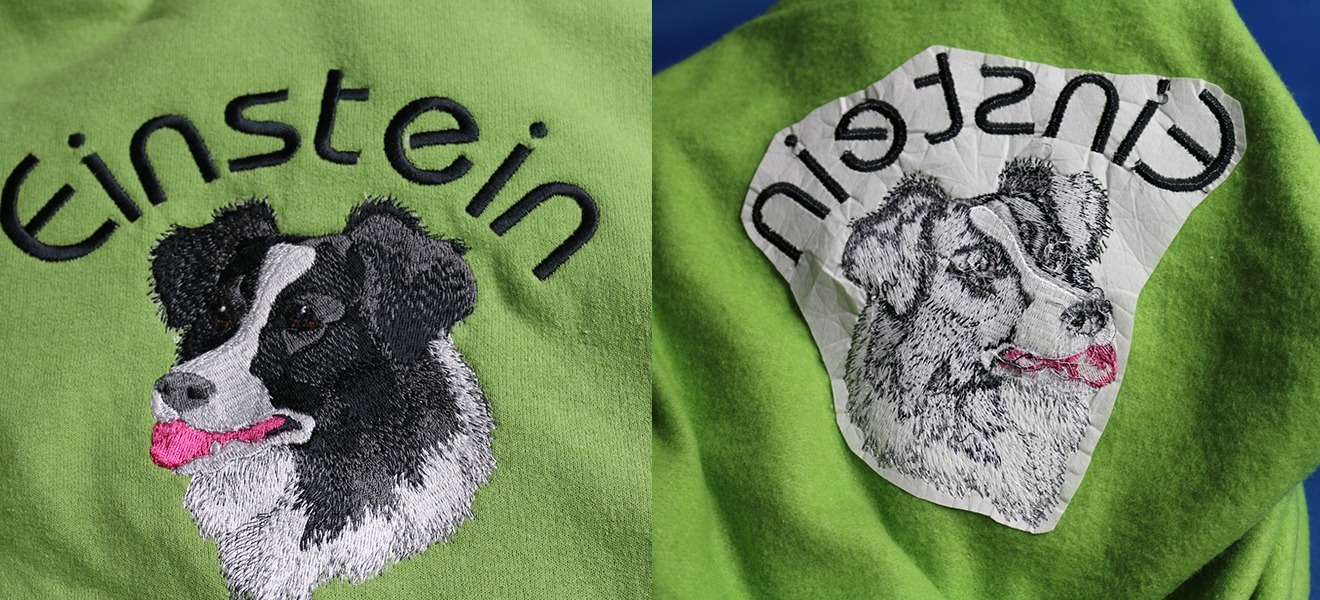
Then choose the weight by the fabric's weight and your design's stitch count. For example, use No Show 1.5 oz for a left-chest logo on a T-shirt, and Cutaway 2.5 oz for a large design on a sweatshirt. Add a water-soluble topping on terry, fleece, pique and other textured fabrics so stitches don't sink.
Choosing the right stabilizer streamlines finishing, cuts machine downtime and stops garment loss. The chart below matches common commercial fabrics to the TES stabilizer we recommend for each.
The four types of embroidery stabilizer
| Type | What it does | Use it on |
|---|---|---|
| Cutaway | A permanent foundation. It stays in the garment, and you trim the excess close to the design. | Knits and anything that stretches: T-shirts, polos, sweatshirts, performance wear |
| Tearaway | Tears cleanly from the back after stitching. The part under the stitches stays and supports them, with no halo around the design. | Stable, non-stretch fabrics: woven shirts, twill, denim, canvas, nylon jackets, caps |
| Washaway (water-soluble) | Dissolves completely in water and leaves no trace. | Freestanding lace, patches, sheer or open-weave fabrics, and as a topping on pile fabrics |
| Specialty | Fusible, adhesive, heat-removable and flame-retardant stabilizers for jobs the standard types can't handle. | Hard-to-hoop items, leather, vinyl, sheers, silk, appliqué, children's sleepwear |
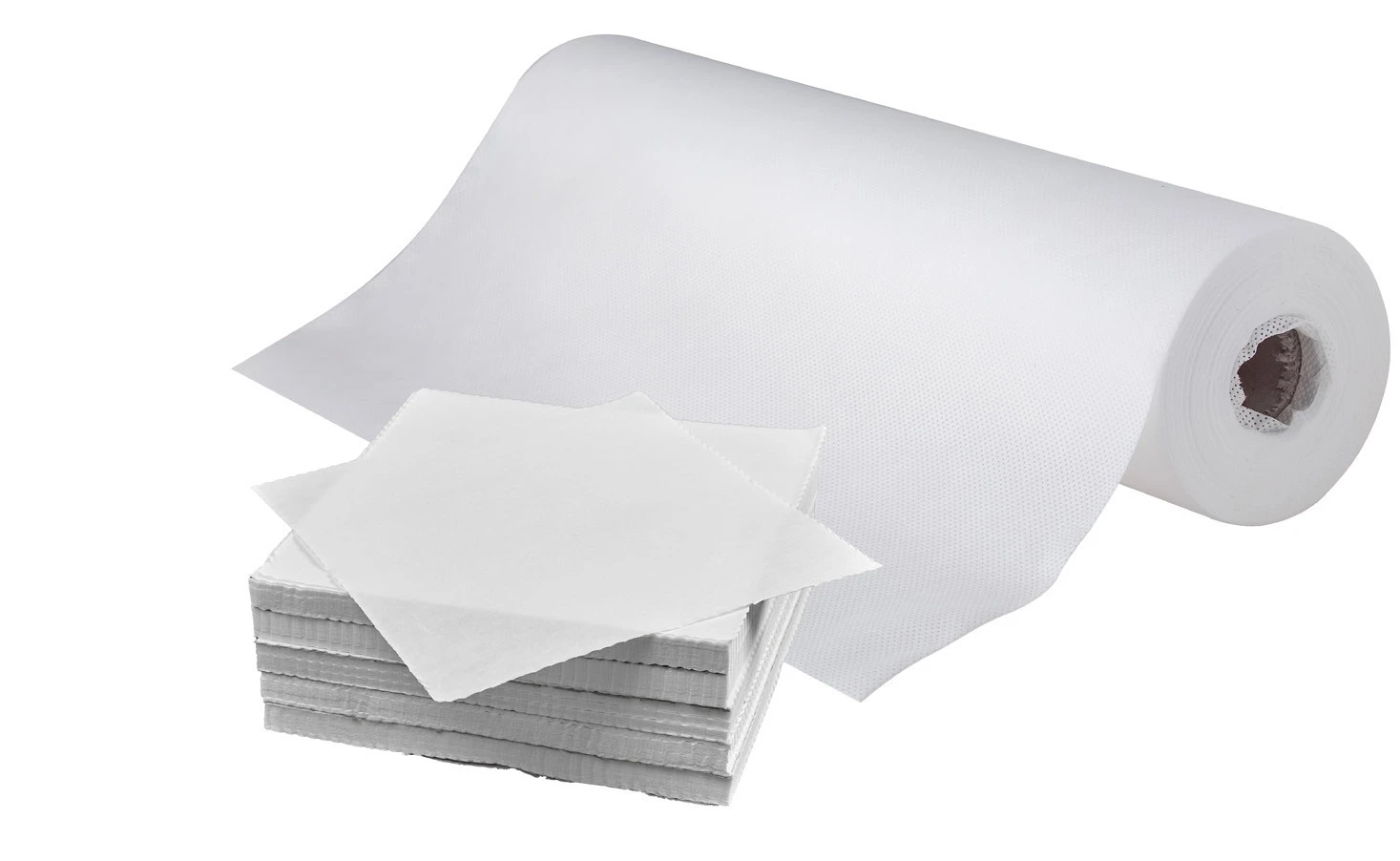
Soft vs firm tearaway
Tearaway comes in two styles:
- Firm tearaway is crisp and paper-like, with more cellulose. It tears cleanly right to the stitch line. Use it on wovens and other stable fabrics with light to medium stitch counts.
- Soft tearaway has more polyester fiber, so it holds more stitches and stays pliable. Use it on semi-stable fabrics, children's wear, denim and canvas, or when dense fill stitches would break down a firm tearaway before the outlines are sewn.
Embroidery stabilizer chart by fabric
Needle key: LBP = light ball point · ESBP = extra slim ball point (universal) · SP = sharp point
On a phone, swipe the chart sideways to see every column.
| Fabric or item | Recommended TES stabilizer | Needle |
|---|---|---|
| T-shirts and lightweight knits (cotton or blends) | No Show 1.5 oz for left chest; Cutaway 2.0 oz for larger designs | 70/10 or 75/11, LBP or ESBP |
| Light-colored lightweight knits | No Show 1.5 oz or Soft Sheer 1.3 oz, so the stabilizer doesn't show through | 70/10 or 75/11, LBP |
| Sweatshirts | No Show 1.5 oz for small designs; Cutaway 2.5 oz for larger designs. Add Water Soluble Topping on heavily ribbed fleece for cleaner edges. | 75/11, LBP |
| Pique polos | Cutaway 2.5 oz with Water Soluble Topping | 75/11, LBP |
| Heavy knits (thermal, cable, rib) | No Show 1.5 oz with Water Soluble Topping | 75/11 to 85/13, LBP |
| Pile fleece (blankets, jackets) | Soft Tearaway 1.5 or 1.8 oz for small or light designs; No Show 1.5 oz for high stitch counts. Add Water Soluble Topping. | 75/11 or 80/12, LBP |
| Performance, moisture-wicking and spandex | Stabil Sport or PolyPro Performance. Float Soft Tearaway under the hoop for dense designs. | 70/10 or 75/11 (65/9 to 70/10 for spandex), LBP |
| Broadcloth, poplin and quilting cotton | Firm Tearaway 1.8 or 2.5 oz | 70/10 or 75/11, ESBP or SP |
| Canvas and denim (non-stretch) | Soft Tearaway 1.5 or 1.8 oz, or Firm Tearaway 1.8 or 2.5 oz | 75/11 to 85/13, ESBP or SP |
| Lightweight nylon (10D–70D) | Soft Tearaway 1.5 or 1.8 oz, or Tear 'N Wash | 70/10 or 75/11, ESBP or SP |
| Stiff nylon (100D and above) | Firm Tearaway 1.8, 2.5 or 3.0 oz. On coated nylon, try cutaway with temporary spray adhesive. | 80/12, SP |
| Satin (polyester or acetate) | Firm Tearaway 1.8 oz or Soft Tearaway 1.5 oz; Soft Tearaway 1.8 oz for high stitch counts | 70/10 or 75/11, LBP |
| Silk charmeuse | Hoop Soft Tearaway 1.5 or 1.8 oz; float Firm Tearaway 1.5 oz under the hoop | 65/9 or 70/10, LBP |
| Sheer fabric, transparent | Sew 'N Heat, 2 layers | 65/9 or 70/10, ESBP or SP |
| Sheer fabric, opaque | Firm Tearaway 1.5 oz, one or more layers (remove one at a time) | 65/9 or 70/10, ESBP or SP |
| Caps | Cap Backing 3.0 or 3.5 oz | 80/12 to 90/14, ESBP or SP |
| Terry towels | Firm Tearaway 1.8 oz, Tear 'N Wash or Adhesive Sew 'N Wash, with Water Soluble Topping | 75/11 or 80/12, LBP or SP |
| Velvet | Peel 'N Stick 2.5 oz with Water Soluble Topping | 70/10 or 75/11, ESBP or SP |
| Faux fur | Peel 'N Stick 2.5 oz, or Soft Tearaway 1.5 or 1.8 oz, with Water Soluble Topping | 75/11 or 80/12, LBP |
| Leather, thin or fragile | Cutaway 2.5 oz or Fusible No Show; float the leather with temporary spray adhesive | 70/10 or 75/11, ESBP or SP |
| Leather, thick or spongy | Cutaway 2.5 oz for high stitch counts; Soft Tearaway 1.8 oz for low to moderate | 75/11 to 85/13, LBP |
| Vinyl | Soft Tearaway 1.8 oz, or Cutaway 2.5 oz for high stitch counts; adhere with spray adhesive | 70/10 or 75/11, ESBP or SP |
| Gauze | Adhesive Sew 'N Wash or Tear 'N Wash, with Water Soluble Topping | 70/10 or 75/11, ESBP or SP |
| Socks | Adhesive Sew 'N Wash or Peel 'N Stick, with Water Soluble Topping | 75/11, LBP |
| Freestanding lace | Sew 'N Wash, 2 layers | 70/10 or 75/11, LBP |
| Patches (poly patch twill) | Heat Seal Film to attach the finished patch | 75/11, SP |
For quick answers at the machine, the TES Application Guide PRO puts this whole chart in a handy guide, with a pro tip for each fabric.
What stabilizer ounce weights mean
The ounce weight tells you how much support a stabilizer gives: the higher the number, the more it holds. Match the weight to two things. First, the fabric: heavier, stretchier fabrics need more. Second, the stitch count: dense designs need more support than light outlines or small text.
TES names stabilizers by ounce weight instead of light, medium, and heavy. If you're reordering from an older invoice, or coming over to us from another brand, here is how the old names map to the new ones:
| Old name | New name | Typical use |
|---|---|---|
| Light Cutaway | Cutaway 2.0 oz | T-shirts and lightweight knits, low to medium stitch counts |
| Medium Cutaway | Cutaway 2.5 oz | Pique, fleece, medium knits, medium stitch counts (our most popular cutaway) |
| Heavy Cutaway | Cutaway 3.0 oz | Heavy fleece and jackets, large stitch counts |
| Light Firm Tearaway | Firm Tearaway 1.5 oz | Light stitch counts on stable fabrics |
| Medium Firm Tearaway | Firm Tearaway 1.8 oz | Light to medium stitch counts on jackets and wovens |
| Medium Soft Tearaway | Soft Tearaway 1.5 oz | Children's wear, fleece, wovens |
| Heavy Cap Backing | Cap Backing 3.0 oz | Low to medium stitch counts on caps |
Do you need two layers of stabilizer?
Usually not, if it's a quality wet-laid stabilizer. Many embroiderers were taught to hoop two or three layers. That habit comes from dry-laid backings, also called carded or random saturate. Their fibers are spread unevenly, so they have thin, weak spots and stretch unless you stack layers.
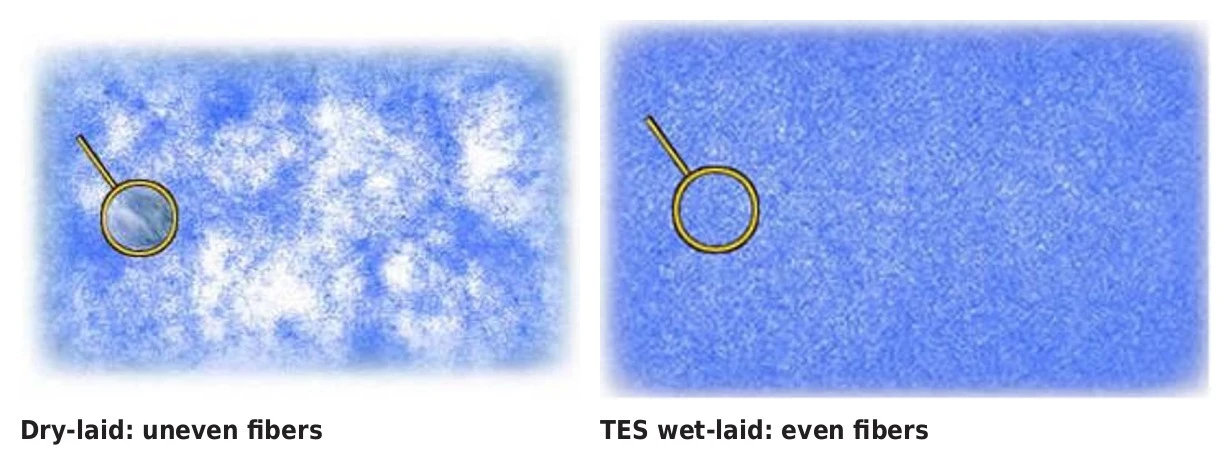
TES stabilizers are wet-laid. The process spreads the fibers evenly, so one sheet does the job:
- Consistent strength across the whole sheet, with no thin areas under the design
- A smoother, flatter surface, so the needle goes through more cleanly and thread breaks less
- Less distortion on dense, high stitch count designs
- Made for high-speed commercial machines. TES wet-laid cutaways also contain silicone, which lubricates the needle.
One layer saves material, hooping time and bulk on the back of the garment. A few delicate fabrics are the exception: two layers of Sew 'N Heat for transparent sheers, two layers of Sew 'N Wash for freestanding lace, and Firm Tearaway floated under the hoop for silk charmeuse.
How to choose the right stabilizer in 5 steps
- Puckering partway through a design? Stop the machine, slide a piece of lightweight tearaway under the hoop, and restart.
- The hoop should be firm and evenly tight, with the fabric smooth but not stretched.
- Removing topping: Tear away the large pieces. Then lay a damp paper towel over the design and press with medium-high heat; the leftover bits lift off with the towel.
- Topping rinse: Mix 1 part fabric softener with 12 parts water in a spray bottle to dissolve leftover topping. Test it on the fabric first.
- Towels without crushed loops: Iron Fuse 'N Tear to the back of the embroidery area. Then hoop Peel 'N Stick with the release paper facing up, score and peel the paper, and press the towel onto it.
- Velvet: pull the topping away after the underlay stitches and before the final layer, so you don't need water to remove it.
- Caps: always support the crown. A well-stabilized cap reduces shifting and helps keep bobbin tension even.
- Stretch garments (spandex, socks): stretch the fabric slightly while hooping to build in the ease it will have when worn.
Common stabilizer mistakes
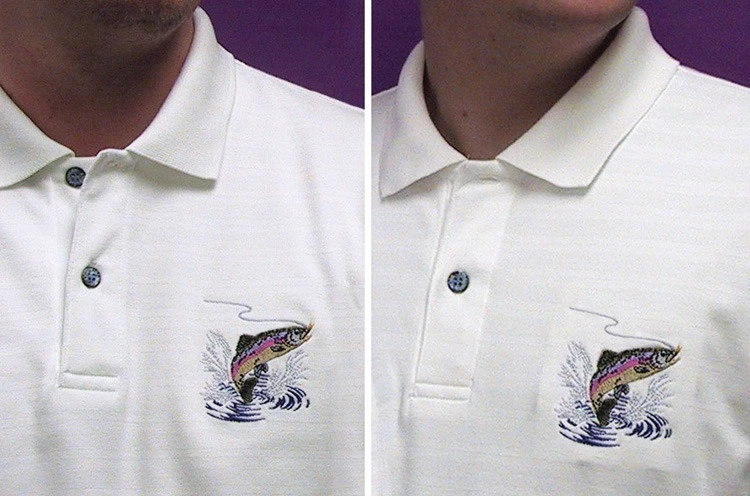
- Using tearaway on knits. Tearaway breaks down under fill stitches, the knit shifts, and the outlines stitch off target. Knits need cutaway.
- Stacking layers of cheap stabilizer. Several layers of dry-laid backing add bulk without the even support of one wet-laid sheet.
- Choosing by habit, not by stitch count. A heavy fill on a 2.0 oz cutaway can pucker. A light outline on a 3.0 oz cutaway leaves a stiff patch on a soft shirt.
- Skipping topping on textured fabrics. Without it, stitches sink into terry, fleece and pique, and the design looks thin.
- Letting stabilizer show through light fabrics. On light-colored, lightweight knits, use No Show 1.5 oz or Soft Sheer 1.3 oz instead of a standard white cutaway.
Frequently asked questions
Q.What are the four types of embroidery stabilizer?
Cutaway, tearaway, washaway (water-soluble) and specialty. Cutaway stays in the garment for stretchy fabrics. Tearaway tears off stable fabrics. Washaway dissolves in water. Specialty stabilizers are fusible, adhesive or heat-removable for hard jobs.
Q.What does the ounce weight of a stabilizer mean?
It shows how heavy, and so how supportive, the stabilizer is. Higher numbers hold more stitches. For example, a 2.0 oz cutaway suits a large design on a T-shirt, and a 3.0 oz cutaway suits a heavy jacket with a dense design.
Q.How do I know which stabilizer to use?
Start with the fabric: cutaway if it stretches, tearaway if it doesn't. Then raise the weight for higher stitch counts, and add topping on textured or pile fabrics.
Q.Can I use tearaway on a T-shirt?
It isn't recommended. Tearaway breaks down under dense stitching, and the knit shifts, which throws the outlines off. Use No Show 1.5 oz for a left-chest design, or Cutaway 2.0 oz for larger designs.
Q.Do I need two layers of stabilizer?
Not with a quality wet-laid stabilizer. One layer gives even support across the whole design. The exceptions are delicate fabrics such as transparent sheers, silk and freestanding lace, which call for a second layer.